What Is a Case Data Review Versus a Case Interview
How to Solve a Example Written report – A Structured Approach
This approach will allow you to crevice any blazon of instance study. Solving a case in a example interview is not very unlike from the approach a consultant uses in real life to solve clients' bug. You will demand to:
- Develop an exhaustive structure that will guide you throughout the case interview efficiently. The construction ideally will tell you where to look for the solution to the problem
- Develop a hypothesis early on and prioritize the information you need to gather. Utilise the 80/20 dominion to effigy out which respond to what question volition accept the biggest impact on the example solution (eighty/20 rule or Pareto Principle);
- Gather data and know why you need the information and what conclusions tin you depict which would ultimately help you go to the solution
In a case interview, your but source for data is the Interviewer. Hence, it is important that yous establish open bi-directional communication and obviously, your rapport with the interviewer is very important.
Make sure you ask for only relevant information and ideally let the interviewer know why you demand a particular piece of information, exist every bit open up and transparent in your idea process as possible, and call back out loud to allow the interviewer know your thinking procedure including your electric current hypothesis.
The Interviewer volition likely provide exact information or charts based on your questions.
How to Approach a Case Study in 4 Steps
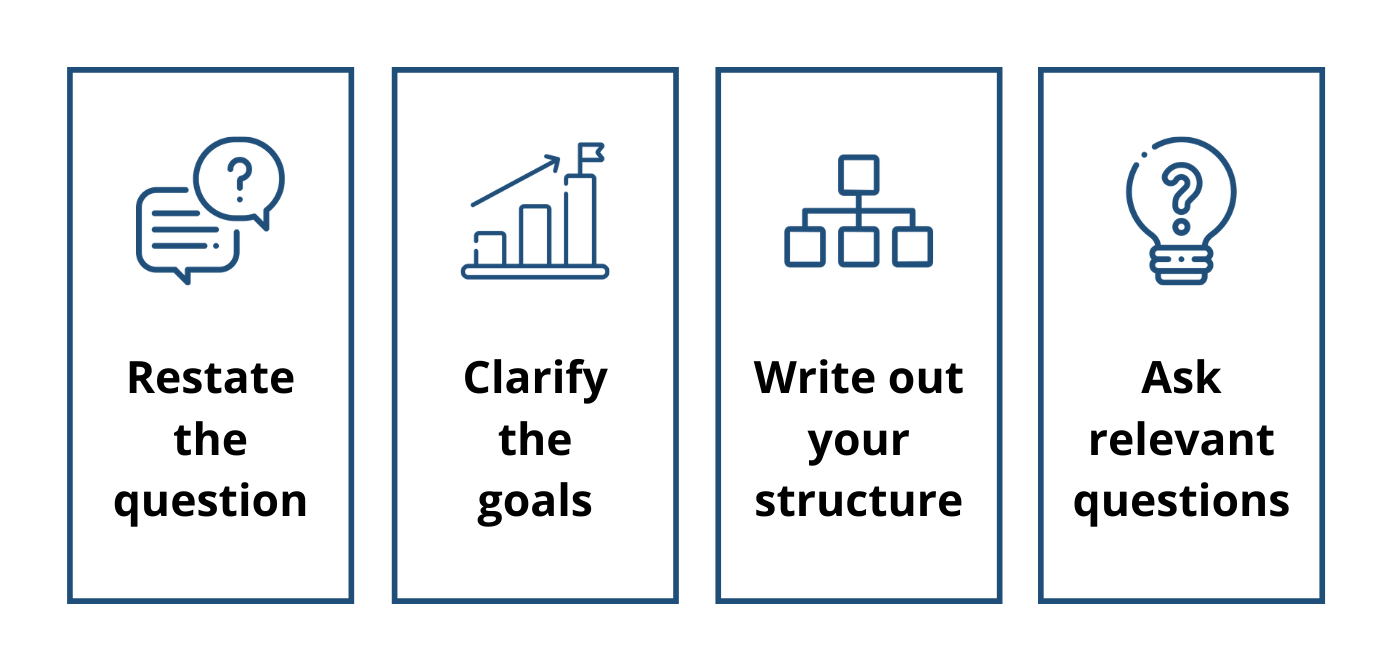
The foundation for a successful case is set at the beginning then follow these steps religiously during your interview practice:
1. Recapitulate the question and brand sure you sympathize the problem argument by confirming with the interviewer
Understand the trouble actually well before structuring or asking for data. Do non simply repeat the question but rephrase it in such a way that it would avoid misunderstandings. This is important because in consulting, it is crucial to sympathize the needs of the customers.
two. Clarify the goals
Enquire specific questions to clarify goals. "So our objective is to increase the bottom line. Are there whatever other objectives I should know of?" If there is more one objective, do non try to solve them all at once, instead, break the problem into pieces and solve one piece at a time. This will allow y'all to stay focused.
3. Write out your structure
First,ask your interviewer for a minute to prepare your structure since this part is extremely important and determines whether you will succeed in solving the case. Don't be afraid of the silence! Practice structuring the example! If you take a skillful structure that is Mutually Exclusive Collectively Exhaustive (MECE), y'all do non have to worry about running into expressionless ends because fifty-fifty if you do, you can dig downward an alternative branch that volition ultimately assistance you solve the instance. Utilise an issue tree to help in customizing your structure.
4. Ask questions to empathize the trends of the client, industry, and production
Enquire questions nearly the firm's business model, the land of the contest and its substitutes, the firm's position inside the manufacture, and the product. Make certain to ask near changes (or deltas) [how/if things have changed]. Example categories
- What is the electric current situation of the client
- What has inversefrom previous years
- What are the fiscal (& non-fiscal) predictions given the electric current situation
Client:
Don't be afraid to ask questions well-nigh the business model. Fifty-fifty if you accept graduated with a business degree, it is impossible to know a company's business model without investigating details. Thus, solving a case based on imitation assumptions is worse than asking a question you lot call up you should know beforehand. Typically, you lot'd desire to know:
- The size of the company
- Whether it is profitable and growing
- How a business transaction works within the company
- How is the product being produced and what are some crucial production steps?
Manufacture:
For cases where external factors are decisive (e.thousand. market place entry), yous may want to know:
- At which indicate of the lifecycle is the industry?
- What is its configuration?
- Who are thecentral players?
- Who are the suppliers?
- What is the client's position relative to other firms?
- What has changed? Who has left the industry? Who has recently entered the market? Why? Take any of the competitors changed their pricing? What about ownership behavior?
- Was in that location a alter in regulations?
- What are the major substitute products?
- What are the future predictions about the marketplace?
(For a systematic view, encounter Porter's 5 Forces)
Production:
In some cases, the crux of the matter is the product. In these cases, you desire to know:
- What exactly is the production? What does it do? What are its strengths/weaknesses? What is it mainly used for? Has there been a change in the fashion information technology is existence used?
- What is the lifecycle of the product? Is it still in the evolution stage or nearly to go outdated?
- How is the brand/reputation?
- How practise competitors' products perform in comparing? What are their strengths/weaknesses?
- Who are the customers? How are they segmented? What do they need? Has the need changed recently (due east.g. connectivity, "eco", social)?
- What is the price of the production? How is the cost compared to competitors?
- How is the product being promoted? Has a competitor recently inverse its promotion activities?
- What are the distribution channels? Is the sales place where the customers are? Take new distribution channels emerged recently?
- What is the service (east.g. after-sales) like? How does information technology compare to competitors? Has in that location been a change?
- Closely related to the industry part: Are there any new technologies or products on the market?
- What does the production consist of? What are the parts and where are they sourced?
(For a systematic view, see 4 Ps Framework)
Case Interview Structure - Your Primal Ability to Ace the Case Study
A key evaluation criterion is your ability to structure a example and being able to adapt the construction throughout the example. A practiced case structure is the about important part of the example. Based on your structure, you will need to interpret the new data and draw conclusions from it. Endeavor to segment your information until you lot accept isolated the problem. If the problem is not captured by your structure, yous will likely non exist able to solve the case. Remember to practice setting up a case structure during your interview preparation.
Visit the result tree lesson to learn how to prepare a good construction
What the Interviewer expects to see
- An excellent ability to communicate; i.e. stating the conclusion/result first and providing the reason why afterwards by applying the pyramid principle
- Solid and flexible problem-solving skills, which includes the ability to break a problem down into its parts, think qualitatively and quantitatively about the problem and refine your hypothesis according to new information and insights
- Creativity
- Business concern judgment and logical reasoning
- Thoughtful questions
- Identify the well-nigh likely and efficient solution and weigh upwards the pros and cons and the implementation potential
- Generate actionable recommendations
- Being considerate
Virtually candidates fail in example interviews because of their inability to set up a skillful and well-thought-through structure
Note-taking is key to setting upwards a practiced structure: do the skill!
The structure is a very important office of the case interview. In fact, in nigh cases when candidates do non become a laissez passer in their interview it is because of their inability to structure the problem. Ideally, you should structure your case based on two categories:
- Incoming information which you receive and procedure
- Outgoing information which you communicate to your case partner
To testify your interviewer how you structure, you demand to display how you receive and process information mentally and how you would limited your thoughts to a potential client. Taking good notes helps in:
- Understanding the structure
- Remembering the structure
- Referring to the structure when required
Your interviewer will usually non give you all the information that is necessary to solve the case.
To exist able to spot missing information and be organized, use the following arroyo:
-
Get together data
-
Organize information and make conclusions
-
Support conclusions with data assay
For all three tasks, use a different sheet of newspaper and n alwayswrite on the back of these sheets. During stressful situations such as a instance interview, you run intoa high hazard of losing track of where the data is if you cannot meet everything on one side of the sheets.
The post-obit examples bear witness how the arrangement applies in do while taking notes:
ane. Gather information
You gather information and take notes only at the beginning of the case. Make certain you don't miss any details, especially if the interviewer is providing you with numerical data.
2. Organize information and make conclusions
This step is extremely crucial(organizing initial information and interpreting it). Here, y'all would want to build aframework for your arroyo and structure your hypotheses using an issue tree.
Start testing your hypotheses based on your structure and adapt it according to your results (whether the hypothesis is true or non). Use this particular sheet equally a guide whenever y'all run into dead ends and to go along you structured. This arroyo will help you in clarifying your approach to the interviewer and yourself at every step of the analysis considering it forces you to regularly brand sub-conclusions and recaps. Use landscape format and every bit much graphic support as possible. This manner would also demonstrate to the interviewer that you lot think like a consultant.
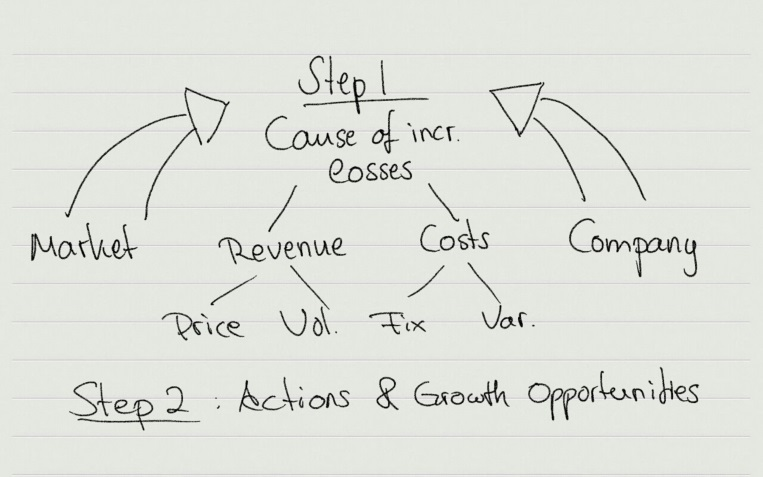
three. Support conclusions with information analysis
Make certain you focus on information that is relevant and important to answer the example problem.This will demonstrate to your interviewer that you don't blindly annotation down everything. Thus, before analyzing anything, it would make sense to paraphrase in your head and write only relevant information. Make sure to take notes in a structured manner. This will ensure that you will recollect the relevant instance data and have quick access to it even during a stressful interview. To summarize, before noting downwards and sharing the data with the interviewer,analyze it and determine its relevance.
Finally, you should take a crude sheet just for doing calculations. Subsequently finishing your calculations make sure you transfer the result to the corresponding part of the structure on the other sheet.
four Commandments to Ace Your Case Interview
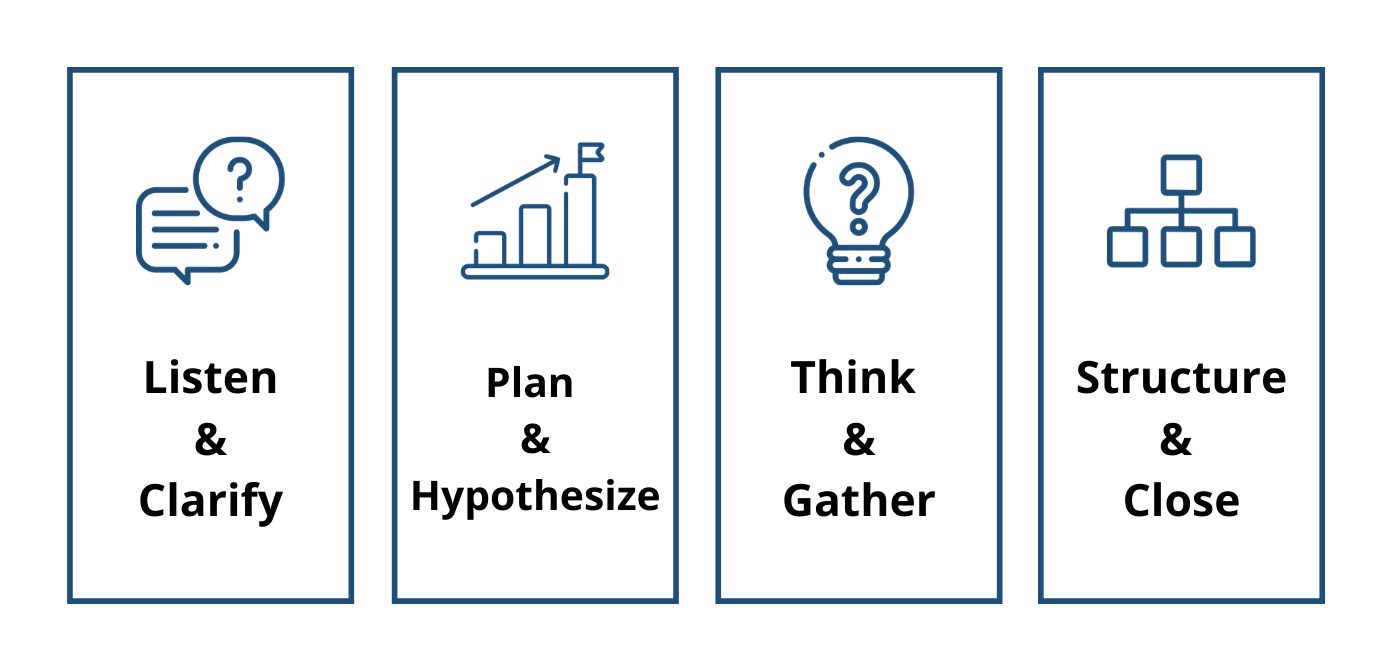
In this section, we will become over what nosotros call the 4 commandments of case corking. The 4 commandments will assistance you lot get through almost any example in a structured and goal-oriented way.
The 4 commandments:
- Listen & Clarify
- Plan & Hypothesize
- Think & Gather
- Structure & Close
1. Listen & Clarify
Listen actively
- Focus and concentrate!
- Write downEVERY piece of data, especially numerical data
Pause, paraphrase the problem, and analyze all questions
- Example: "Then, if I understood yous correctly…"
- Double-bank check on theobjective: "Is reducing production costs our only goal in this case?".Don't be afraid to inquire - make sure youunderstood the problem100%
2. Plan & Hypothesize
Plan the solution structure (roadmap)
- Ask for i infinitesimal to gather your thoughts
- Identify example type and corresponding framework
- Draw and draw the framework you want to employ for the interviewer
- Ideally, you should start with the trouble you want to solve (eastward.thou. "To assess the market size I will be trying to calculate the number of diapers sold in the United states per year")
- Then lay out how you desire to become there and where you will utilise assumptions
- Organize your notes (consultants are supposed to always be "client-ready")
List hypotheses
- Ever listing a few possible hypotheses and set out with one of them (due east.chiliad. "Since yous take mentioned that revenues are more than or less flat, my hypothesis is that the problem is mostly driven by the cost side of the business. If information technology is ok with you I will start by analyzing this side of the Profit tree first.")
- Start with the corresponding branch of the framework
- Refine/rebuild hypothesis equally y'all discover out more
3. Think & Gather
Think out loud
- The interviewer is interested just has no crystal ball. You have to tell him what you are thinking
- Sharing your thoughts allows the interviewer to interact. He will give you lot hints such as nodding if you are on the right track
- If you always get stuck, the interviewer is in a better position to assist y'all out since he knows where you are in your idea process
Thinking aloud is client-friendly!
Gather data the right mode
- ALWAYS segment your data (e.thou. using the ABC assay)
- Proactively ask for relevant information
- Don't be likewise vague in your questions. ("Why are profits declining" is a bad question. "And then, profits have been declining. Does the client have any information about contempo changes in either the revenues or the toll position of the company?" is better)
- Quantify whenever possible ("By how much accept revenues been declining?")
- Go for various tendency data (this twelvemonth vs. terminal years OR client vs. competition)
- Try to evaluate whether trends have been company-specific or industry-wide
four. Construction & Close
Stay structured throughout the case
- Always refer to the structure you take set upwardly at the first of the case
- Remember: be flexible with your structure as the instance evolves
- Don't jump around framework branches without finishing analyzing a branch, always solve problems serially
- Explore branches of your result tree and eliminate them when you lot reach a dead-end
- Summarize findings when switching major branches. This can also be done during the case
- Exist MECE!
Close the instance properly
- Inquire for 30 secs to a minute to gather your thoughts (try to draw them)
- Cull a recommendation and stand up past it!
- For consulting projects, it is of import to take a clear recommendation
- Your recommendation must exist action-oriented
- Your interviewer will probable challenge your recommendation (either to run across if you can handle force per unit area or to assess if you really believe in what you are maxim): stand past your recommendation (apparently within reasonable limits)
- When communicating your solution, put the most interesting part get-go: commencement decision/recommendation then justification
- Do not go over the analysis in your recommendation and focus on the important effect ("Here is what you lot should do: [...] and this is why: [...]")
- People similar 3: give the interviewer iii reasons
- Instance Interviews are an important part of candidate assessment where communication, problem-solving ability, business judgment, and data estimation skills are beingness evaluated
- They are more than standardized and better to gear up for than you might think. How to successfully prepare for a example interview depends a lot on your willingness toDo. PrepLounge and most Case Interview resources recommend at least thirty case simulations before you go to your first real interview
- You demand to get used to a structured approach of problem-solving that is like to how a real-life appointment is approached
Fundamental Takeaways:
- Follow the 4 Commandments
- Go a feeling and truthfulunderstanding of the problem and the objective
- Lay out an exhaustive, well-thought-throughconstruction
- Build an initialhypothesis andprioritize the different areas
- Assemble databased on your hypothesis and priorities
- Evaluate the data keeping in mind your problem and goal
- Track down the root cause and the area which would have the biggest impact
- Develop possible solutions, weigh them, and cull the best one. Brand sure your solution is based on the data irrespective of whether it is positive or negative. Keep in listen that thebest feasible solution is truly the best solution!
Do y'all demand more insightful tips on how to arroyo your instance interview in direction consulting? Read our comprehensive case interview guide that gives y'all tips for your instance interview preparation, step-by-step explanations to solve the instance, and lastly xiii valuable tips for your actual interview day.
Source: https://www.preplounge.com/en/bootcamp.php/interview-first-aid/crack-the-case-interview/approaching-a-case

Postar um comentário for "What Is a Case Data Review Versus a Case Interview"